
Car maintenance often feels like just another task on an impossibly long to-do list. Between work, family, and trying to find a moment for yourself, who has time to sit in a waiting room? But what if taking care of your car didn’t have to disrupt your life? The secret is preventive car maintenance: a strategy that saves you time and stress by catching small issues before they become major, schedule-wrecking emergencies. This guide covers everything from mileage-based service schedules to cost breakdowns, with tips tailored to Las Vegas drivers who deal with 115-degree summers and dusty desert roads.
Key Takeaways
- Proactive care saves money and stress: Regular maintenance catches small issues before they turn into major breakdowns. According to AAA, drivers who skip routine service spend an average of $1,200 more per year on emergency repairs than those who follow a maintenance schedule.
- Your owner’s manual is the best guide: It tells you the correct service schedule for your specific car and debunks outdated rules about 3,000-mile oil changes or premium fuel requirements.
- Las Vegas heat accelerates wear: Extreme summer temperatures (115°F+) shorten battery life by 33%, degrade coolant faster, and increase tire blowout risk. Desert drivers need a more aggressive maintenance schedule than what’s printed in the manual.
- Mobile service removes the biggest barrier: On-site maintenance brings the garage to your driveway, saving you 2-4 hours per visit. Subscription plans make costs predictable so car care becomes automatic.
What Is Preventive Car Maintenance?
Preventive car maintenance is a schedule of regular inspections, fluid changes, and part replacements designed to keep your vehicle running safely and efficiently. Think of it like your annual health check-up: you go not because you’re sick, but to make sure everything is working and to catch potential problems early.
This approach shifts car care from a reactive scramble (something breaks, you panic) to a calm, controlled routine. Instead of waiting for a warning light to derail your week, you stay ahead of wear and tear so your car remains reliable.
A thorough preventive maintenance routine includes:
- Fluids: Checking and topping off engine oil, coolant, brake fluid, power steering fluid, and transmission fluid
- Tires: Monitoring pressure, inspecting tread depth, and rotating every 5,000-7,000 miles
- Brakes: Inspecting brake pads, rotors, and brake fluid condition
- Battery: Testing voltage and cleaning terminals, especially before extreme weather seasons
- Filters: Replacing engine air and cabin air filters on schedule
- Belts and hoses: Inspecting for cracks, fraying, or brittleness
- Lights: Verifying headlights, brake lights, and turn signals work properly
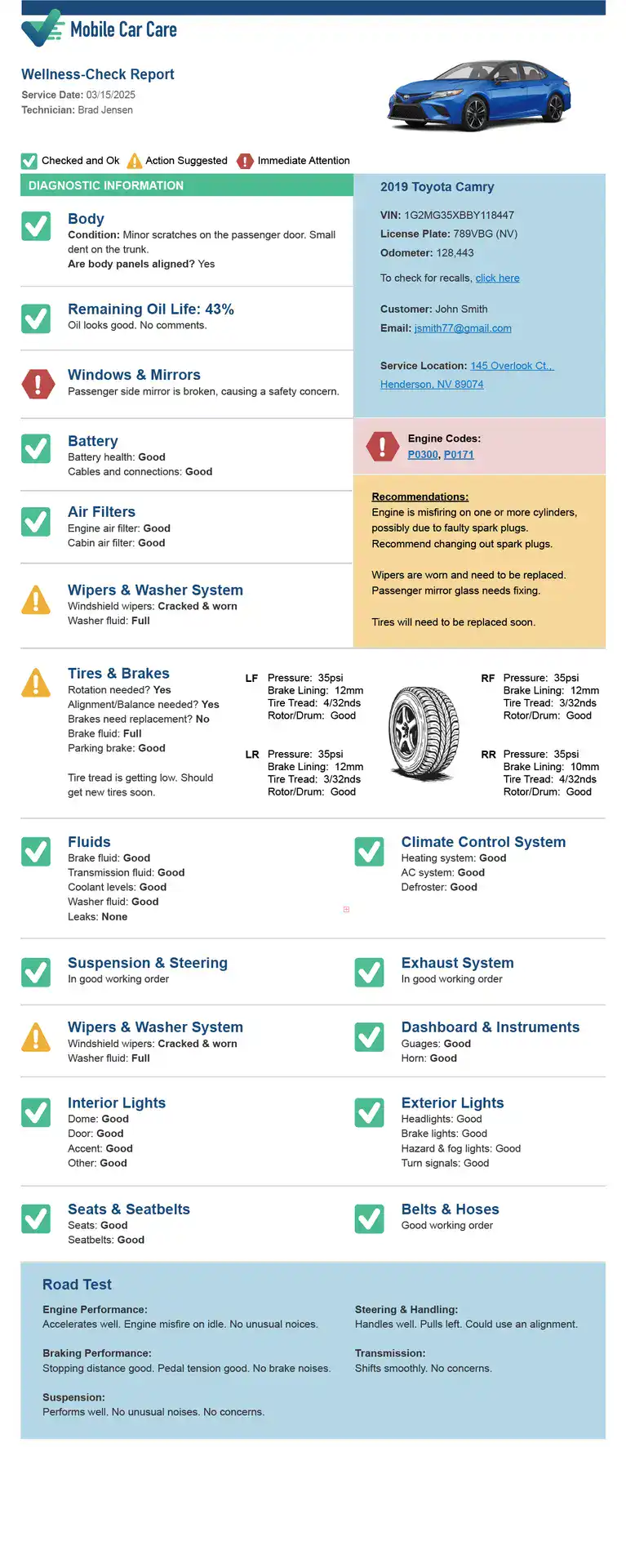
Mobile Car Care’s 85-point inspection covers all of these items and more. Every check produces a detailed digital report with photos and recommendations, so you know exactly where your car stands.
Maintenance Schedule by Mileage: What to Do and When
One of the most common questions drivers ask is “when should I service my car?” The answer depends on your mileage, your driving conditions, and what your owner’s manual recommends. This table gives you a general framework. Always cross-reference with your specific vehicle’s manual.
The Mileage-Based Maintenance Chart
| Mileage Interval | Service Tasks | Why It Matters |
|---|---|---|
| Every 3,000-5,000 miles | Oil and filter change (conventional oil) or every 7,500-10,000 miles (full synthetic); tire pressure check; visual inspection of lights and wipers | Clean oil prevents engine sludge and overheating. Proper tire pressure improves fuel economy by up to 3%. |
| Every 5,000-7,000 miles | Tire rotation; brake inspection | Even tire wear extends tire life by 20% or more. Early brake checks catch thin pads before rotors get damaged. |
| Every 15,000-30,000 miles | Replace engine air filter and cabin air filter; inspect serpentine belt; check coolant condition | Clogged filters reduce engine efficiency and air quality inside the cabin. Desert dust accelerates filter clogging. |
| Every 30,000-60,000 miles | Replace spark plugs; flush coolant system; inspect suspension and steering components; transmission fluid service | Worn spark plugs reduce fuel economy. Old coolant loses its protective properties against corrosion. |
| Every 60,000-100,000 miles | Replace timing belt (if equipped); major brake service (new pads and rotors); replace battery (3-5 year lifespan, shorter in extreme heat) | A snapped timing belt can destroy your engine. Budget $500-$1,000 for this service to avoid a $3,000+ engine repair. |
Tip for Las Vegas drivers: Desert heat and dust mean you should lean toward the shorter end of every interval. If the range says 15,000-30,000 miles for a filter change, plan on 15,000 in the Vegas valley. Mobile Car Care’s quarterly 85-point inspections catch items that fall between these intervals, so nothing slips through the cracks.
Seasonal Car Care for Las Vegas Drivers
Las Vegas isn’t like most cities. You won’t deal with road salt or black ice, but you will face extreme heat that’s harder on vehicles than most drivers realize. Here’s a seasonal checklist built specifically for the desert.
Spring (March-May): Pre-Summer Prep
- A/C system check: Test cooling performance now, before you need it every day. A system low on refrigerant won’t keep up when it’s 110°F outside.
- Coolant inspection: Check coolant level and condition. Desert heat causes coolant to degrade faster. If it’s been 2+ years, consider a flush.
- Battery test: Heat kills batteries faster than cold. The average battery lasts only 2-3 years in Las Vegas (vs. 4-5 years in mild climates). Test now so you’re not stranded in July.
- Wiper blades: Sun exposure makes rubber brittle. Replace wipers before monsoon season arrives in late June.
Summer (June-September): Surviving the Heat
- Tire pressure monitoring: For every 10°F increase in temperature, tire pressure rises about 1 PSI. Over-inflated tires are a blowout risk on scorching pavement. Check your TPMS weekly.
- Coolant and overheating checks: Carry extra coolant in your trunk. Watch your temperature gauge in stop-and-go traffic on the Strip or I-15.
- Oil condition: High heat breaks down oil faster. If you use conventional oil, consider shorter change intervals during summer months.
- Interior protection: UV damage cracks dashboards and fades seats. Use a sunshade and park in shade when possible.
Fall (October-November): Cool-Down Service
- Post-summer inspection: Summer heat stresses belts, hoses, and fluids. A thorough check now catches damage before it causes a breakdown during the mild season.
- Brake inspection: Hot pavement and stop-and-go driving accelerate brake pad wear. Check pad thickness and rotor condition.
- Fluid top-offs: Replace any fluids that degraded over the summer.
Winter (December-February): Desert Cold Catches Drivers Off Guard
- Battery recheck: A battery weakened by summer heat may fail when nighttime temperatures drop into the 30s and 40s. Test the battery and inspect terminals for corrosion.
- Tire tread check: Rain is rare but dangerous in the desert. Worn treads on dusty roads and occasional wet pavement are a skid risk.
- Heater and defroster test: These systems sit unused for months. Make sure they work before that first cold morning commute.
- Snowbird vehicle prep: If you store a car during the off-season, follow our Las Vegas car storage tips to avoid dead batteries, flat-spotted tires, and rodent damage.
How Much Does Car Maintenance Cost? DIY vs. Mobile Service vs. Shop
One of the biggest reasons drivers skip maintenance is cost uncertainty. Here’s a realistic breakdown of what common services cost across three options, so you can pick the approach that fits your budget and schedule.
Cost Comparison Table
| Service | DIY Cost | Traditional Shop | Mobile Service | Notes |
|---|---|---|---|---|
| Oil change (synthetic) | $30-$50 | $65-$100 | $60-$90 | DIY requires tools, jack, and oil disposal |
| Tire rotation | $0 (if you own a jack) | $25-$50 | Included in quarterly inspection | Shops often bundle with oil change |
| Brake pad replacement | $40-$80 (parts) | $150-$350/axle | Referred to partner shop | DIY needs jack stands and basic tools |
| Battery replacement | $100-$200 (battery) | $150-$300 | $100-$200 + labor | Mobile service saves a tow if battery is dead |
| Air filter replacement | $15-$30 | $40-$70 | Included 1x/year (Essential Plan) | One of the easiest DIY tasks |
| Cabin filter replacement | $15-$25 | $40-$80 | Included 1x/year (Essential Plan) | Replacement frequency higher in dusty climates |
| Coolant flush | $20-$40 | $100-$200 | Referred to partner shop | DIY requires proper disposal of old coolant |
| Full 85-point inspection | N/A | $100-$200 | Included quarterly (Essential Plan, $29.99/mo) | Catches issues across all major systems |
The real math: Mobile Car Care’s Essential Plan at $29.99/month ($360/year) includes four 85-point inspections, fluid top-offs, tire pressure adjustments, and annual filter replacements. A single full inspection at a dealership costs $100-$200. Two shop visits per year already costs more than the annual subscription, and you still have to drive there and wait.
For drivers who want even more coverage, the Total Care Plan adds oil changes, free jump starts, emergency fuel delivery, and runner service (they pick up your car and take it to a shop for you). Families with multiple vehicles save 10-20% with multi-vehicle discounts.
Your Must-Do Maintenance Tasks
These are the foundation of preventive maintenance. Tackling them on schedule will help you catch small issues before they turn into major headaches.
Check Your Oil and Filters
Engine oil lubricates moving parts and keeps the engine from overheating. Get into the habit of checking your oil level regularly, especially before a long drive. Along with clean oil, a fresh filter is needed to trap dirt and debris. When you get an oil change, always make sure the filter is replaced too.
Care for Your Tires
Your tires are the only thing connecting your car to the road. Once a month, check tire pressure and inspect the tread for wear. Properly inflated tires improve handling, fuel economy, and lifespan. Have your tires rotated every 5,000 to 7,000 miles so they wear evenly. In Las Vegas, check pressure more frequently during summer since heat causes air to expand. And don’t forget to check the spare.
Inspect Your Brakes
Have your brake system inspected during every tire rotation, or about every 6,000 miles. A professional can check the pads, rotors, and brake fluid to make sure everything works. If you hear squeaking, feel a grinding sensation, or notice your car pulling to one side when you brake, get it checked immediately. A brake line inspection is also worth doing annually.
Top Up Fluids
Your car relies on several fluids beyond oil: transmission fluid, coolant, brake fluid, power steering fluid, and windshield washer fluid. Each one plays a role in keeping systems running, from cooling the engine to ensuring smooth gear shifts. Mobile Car Care’s 85-point inspection checks all fluid levels and tops them off as part of the service.
Test Your Battery
A dead battery is one of the most common reasons for a car not starting, and it almost always happens at the worst possible time. Have your battery tested at least once a year. In Las Vegas, test it twice: once in spring (before summer heat) and once in fall. A failing battery caught early costs $100-$200 to replace. A dead battery on the side of I-15 costs that plus a tow, lost time, and a lot of frustration.
Replace Air Filters
Your car has two air filters: the engine air filter and the cabin air filter. The engine filter keeps dirt from entering the engine, helping it run efficiently. The cabin filter cleans the air you breathe inside the car, trapping dust, pollen, and pollutants. In the desert, dust and sand clog filters faster than in other climates. Check them every 12,000 miles (or sooner if you notice reduced A/C airflow or a musty smell).
Check Belts and Hoses
Under the hood, rubber belts and hoses keep critical systems running: your alternator, water pump, and air conditioning. Over time, heat and UV exposure cause rubber to crack, fray, or become brittle. A broken serpentine belt can cause an immediate breakdown. Las Vegas heat accelerates rubber degradation, so visual inspections during regular service are especially important here.
Common Car Maintenance Myths, Busted
Car care advice gets passed down through generations, but a lot of it is outdated. Modern engines and materials have changed the rules. Here are the myths that cost drivers the most money and time.
Do You Really Need an Oil Change Every 3,000 Miles?
That rule made sense decades ago with older engines and conventional oil. Today, most vehicles using synthetic oil can go 7,500 to 10,000 miles between changes. Sticking to the old schedule means you’re spending more money than necessary. Check your owner’s manual for the manufacturer’s recommended interval for your specific engine. If you drive in severe conditions (frequent short trips, extreme heat, dusty roads), you may need changes on the shorter end of the range.
Is Premium Fuel Worth the Price?
Unless your car’s manufacturer specifically requires it, you’re paying extra for no benefit. Most cars are designed to run on regular unleaded fuel. Higher-octane gas won’t harm your engine, but it won’t improve performance or fuel economy either. Check your gas cap or owner’s manual. If it says “recommended” rather than “required,” regular is fine.
Can You Skip Tire Rotations?
Skipping a rotation might seem like a harmless way to save money, but front tires wear faster than rear ones due to steering and weight distribution. Regular rotations even out that wear, extending tire life and keeping your handling balanced. It’s one of the cheapest maintenance tasks with one of the biggest returns.
Is Washing Your Car Just About Looks?
Regular washing protects your car’s body and frame. Dirt, road grime, and (in Vegas) alkali dust eat away at paint and promote corrosion over time. Washing the undercarriage is especially important if you drive on unpaved desert roads. A little soap and water prevents cosmetic damage that lowers resale value.
What Happens When You Skip Maintenance?
Putting off routine service is a gamble with clear odds. Here’s what’s at stake.
Surprise Breakdowns and Expensive Repairs
That strange noise or occasional stutter might be an early warning sign. A fraying belt costs $25-$75 to replace on schedule. Wait until it snaps, and you’re looking at a tow plus $500-$1,500 in repairs. According to the Car Care Council, one in three cars on the road has a neglected maintenance item that could lead to a breakdown.
Safety Risks
Your car is a two-ton machine carrying the most important people in your life. Worn brake pads, thinning tire treads, or a faulty steering component can have serious consequences. Regular inspections give you confidence that your vehicle is safe every time you get behind the wheel.
Lower Fuel Economy and Resale Value
Underinflated tires, dirty air filters, and degraded oil all reduce fuel economy. Simple maintenance tasks can improve gas mileage by 4-10%. When it’s time to sell, a complete service history is one of your biggest assets. A digital inspection report from every quarterly visit creates exactly that record.
How Mobile Car Care’s 85-Point Inspection Works
Mobile Car Care’s inspection is built around one idea: catch problems before they cost you money. A certified technician comes to your home, office, or wherever your car is parked in the Las Vegas valley (Las Vegas, Henderson, and North Las Vegas).
The 85-point checklist covers:
- Safety systems: All lights, brakes/rotors, horn, seat belts, safety warning lights, defroster
- Tires: PSI, wear, damage, lug nut torque, spare tire presence
- Battery: Voltage testing, terminal condition
- Filters: Engine air filter and cabin filter condition
- Fluids: Oil, brake fluid, coolant, power steering, windshield washer, transmission
- Under the hood: Belts, hoses, leak inspection
- Exterior and interior: Body condition, operational checks (shocks, struts, steering, parking brake, exhaust)
- Test drive: Performance evaluation under real driving conditions
After the inspection, you get a digital report emailed to you with photos, observations, and prioritized recommendations. No guessing, no jargon, just a clear picture of your car’s health.
Three ways to get started:
- Quick Check: A one-time 85-point inspection for pre-purchase inspections, road trip prep, or a baseline health check
- Essential Plan ($29.99/month): Quarterly inspections with fluid top-offs, filter replacements, and a 10% multi-vehicle discount
- Total Care Plan: Everything in Essential plus oil changes, jump starts, emergency fuel delivery, and runner service, with a 20% multi-vehicle discount
Car Care for Busy People
Between work deadlines, school pickups, and everything else, finding hours to sit in a dealership waiting room feels impossible. That’s the point of mobile service: the garage comes to you.
While your car is being inspected in your driveway, you can take a work call, eat lunch, or help your kids with homework. The entire process takes about an hour, and you never have to leave your house. Compare that to the 2-4 hours a typical shop visit takes (including drive time, waiting, and the appointment itself).
A subscription plan turns unpredictable car expenses into a fixed monthly cost. You don’t have to remember when your next service is due. Mobile Car Care schedules your quarterly inspections, sends reminders, and handles the details. It’s the “set it and forget it” approach to car care.
This is especially valuable for:
- Parents of teen drivers: Quarterly inspections provide peace of mind that your kid’s car is safe. Teen car care guidance is built into every report.
- Families with elderly parents: Mobile service for elderly drivers preserves independence while ensuring safety.
- Small business fleets: Fleet maintenance with minimal operational disruption and predictable costs.
- Rideshare drivers: Uber and Lyft drivers who depend on their vehicle being reliable every day.
Frequently Asked Questions
What is considered preventive maintenance on a car? Preventive maintenance includes any scheduled service that keeps your car running before something breaks. Oil changes, tire rotations, brake inspections, fluid checks, filter replacements, battery testing, and belt/hose inspections all qualify. The goal is to replace parts that wear out gradually (like brake pads or air filters) before they fail, and to catch fluid degradation or leaks early.
What preventive maintenance does a car need most often? Oil and filter changes are the most frequent items, typically every 5,000-10,000 miles depending on your oil type. Tire pressure checks should happen monthly. Tire rotations and brake inspections are recommended every 5,000-7,000 miles. In hot climates like Las Vegas, add battery testing and coolant checks to your twice-yearly routine.
How much should I budget for preventive car maintenance per year? Most drivers spend $500-$700 per year on routine maintenance for a single vehicle. That covers oil changes, filters, tire rotations, and a couple of inspections. Major interval items (timing belt, coolant flush, brake job) add cost in the years they’re due. A subscription plan like Mobile Car Care’s Essential Plan ($29.99/month) bundles inspections, fluid top-offs, and filter replacements into a predictable $360/year.
Do new cars need preventive maintenance? Yes. Following the manufacturer’s recommended schedule for a new car protects your warranty and establishes a baseline for the vehicle’s health. Oil changes, tire rotations, and basic inspections are needed from the start. Skipping early maintenance can void warranty coverage and allow small issues to develop unnoticed.
How is a mobile maintenance service different from a dealership? The main difference is convenience. Instead of driving to a shop and waiting in a lobby, a technician comes to your home or office. You get the same professional inspection and detailed digital reports without the logistical hassle. Mobile Car Care’s technicians use the same diagnostic tools and follow the same 85-point checklist at every visit.
Why does Las Vegas weather affect car maintenance? Extreme heat (115°F+ summers) accelerates wear on batteries, tires, coolant, belts, and hoses. UV radiation degrades rubber and plastics faster than in moderate climates. Desert dust clogs filters and contaminates fluids sooner. These factors mean Las Vegas vehicles typically need maintenance on the shorter end of every recommended interval.