
No one likes the financial shock of a sudden, major car repair. Many of these expensive failures, especially within the steering system, don’t happen all at once. They begin as small, quiet issues—like a worn-out part or a minor fluid leak—that are simple and affordable to fix if caught early. This is why a routine steering inspection is one of the smartest investments you can make in your vehicle. It’s preventative care that protects your wallet from a much larger, unexpected bill down the road, all while keeping you safer on your daily drives.
Key Takeaways
- Prioritize proactive steering checks: Regular inspections are a critical safety measure, catching small issues like minor fluid leaks or worn parts before they become dangerous failures and lead to expensive repairs.
- Listen for your car’s warning signs: Pay attention to a steering wheel that feels too loose or tight, new squealing or grinding noises, and uneven tire wear—these are clear signals that your system needs a professional look.
- A complete inspection covers more than just steering: A thorough check examines how the power steering, mechanical parts, suspension, and wheel alignment all work together, giving you a full picture of your vehicle’s health and safety.
What is a Steering Inspection (and Why is it So Important)?
Think about the last time you drove. You turned the wheel, and your car went exactly where you wanted it to. That instant, reliable response is something we often take for granted, but it’s all thanks to your car’s steering system. A steering inspection is a thorough check-up of all the parts that connect your steering wheel to your tires. It’s not just about making sure the wheel turns; it’s about ensuring every component is working together perfectly to give you precise control.
This inspection is one of the most critical parts of vehicle maintenance because it directly impacts your safety. It’s a proactive step to confirm your car will respond exactly when and how you need it to, whether you’re navigating a tight parking spot or avoiding a hazard on the highway. It’s about peace of mind, knowing that the connection between you and the road is solid and secure.
How proper steering keeps you safe on the road
A healthy steering system is your direct line of communication with the road. It’s what allows you to guide your car with precision, translating the simple act of turning the steering wheel into the physical turning of your tires. But it does more than just point you in the right direction. A properly functioning system also absorbs bumps and imperfections in the road, ensuring your wheels maintain contact and control without jarring your steering angle. This is essential for maintaining vehicle control, especially when taking corners or driving on uneven surfaces. When everything is working correctly, you get a smooth, predictable ride that keeps you firmly in command.
Catching small issues before they become big problems
The best time to fix a problem is before it actually becomes one. A steering inspection is designed to do just that. During a detailed check, a technician can spot subtle signs of wear and tear—like a minor fluid leak or a slightly worn-out part—that you wouldn’t notice from behind the wheel. If left unaddressed, these small issues can quickly escalate into major failures, leading to expensive repairs and, more importantly, creating serious safety risks. By catching these things early, you can address them simply and affordably. Our one-time Quick Check is a perfect way to get a professional assessment and ensure small concerns don’t turn into big headaches.
How proactive checks can save you money
Regular maintenance can feel like just another expense, but proactive steering inspections are an investment that pays off. Identifying and fixing a worn component or a small leak early on is far less expensive than replacing an entire steering rack that failed due to neglect. Think of it as preventative care for your car. This approach not only keeps you safer on the road but also protects your wallet from the shock of a sudden, major repair bill. Committing to a recurring plan like our Essential Plan ensures these checks happen on schedule, helping you manage maintenance costs and avoid those budget-breaking surprises down the line.
Warning Signs Your Steering Needs Attention
Your car has its own way of communicating, and learning its language is one of the best things you can do for your safety and your wallet. When it comes to your steering system, the signs of trouble are often subtle at first, but they’re almost always there if you know what to look—and listen—for. Paying attention to these early warnings can help you address a small issue before it leaves you stranded on the side of the road or leads to a much more expensive repair. Think of it as a quick conversation with your car to make sure everything is okay.
Strange feelings through the steering wheel
You know how your car feels on a normal day. If that feeling changes, it’s time to pay attention. One of the most direct signs of a steering problem is a steering wheel that suddenly feels different. It might feel much tighter and harder to turn, requiring more muscle than usual to navigate a parking lot or a simple corner. This can point to an issue with your power steering system. On the other hand, you might notice the wheel feels loose or has a lot of “play,” meaning you can turn it a bit before the wheels actually respond. Neither of these feelings is normal, and both are clear signals that your steering components need a professional look.
Telltale noises to listen for while driving
It’s easy to tune out your car’s sounds when the music is on, but sometimes it pays to listen closely. New or unusual noises, especially when you’re turning, are often your car’s cry for help. A high-pitched squealing sound when you turn the wheel often indicates a problem with the power steering belt—it could be worn out or loose. A groaning or grinding noise is another red flag, potentially signaling that your power steering fluid is low or another part of the system is failing. These aren’t sounds to ignore. They are important indicators of underlying issues that need to be addressed to keep you driving safely.
Visual clues, from your tires to under the car
You don’t have to be a mechanic to spot some of the most common signs of steering trouble. Start by looking at your front tires. Do they look like they’re wearing down evenly? If you notice that the inside or outside edges are significantly more worn than the rest of the tread, it’s a classic sign of an alignment problem, which is directly related to your steering. Another easy check is to look at your parking spot after you pull out. A reddish or pinkish puddle under the front of your car is a telltale sign of a power steering fluid leak. Catching these visual signs of wear early can save you from a much bigger repair down the road.
When a warning sign means you should stop driving
Most car issues give you a little time to react, but some steering problems demand immediate action. If your steering wheel suddenly becomes extremely difficult to turn, or if you feel a clunking sensation or hear a loud grinding sound every time you turn, your car is telling you something is seriously wrong. This could indicate a critical failure in a part like the steering column. In these situations, your vehicle may become unsafe to control. The safest thing you can do is pull over as soon as it’s safe to do so, put on your hazard lights, and call for roadside assistance. Don’t try to push through and get home—your safety is the top priority.
What’s Included in a Professional Steering Inspection?
When you feel something is off with your steering, you want peace of mind that a professional is looking at the whole picture. A thorough steering inspection isn’t just a quick glance under the hood; it’s a systematic check of several interconnected systems that work together to guide your car safely. Think of it as a complete health check-up for your car’s directional control.
A technician will examine everything from the fluid that makes turning the wheel easy to the nuts and bolts that connect it all together. This process involves looking at the power steering system, the mechanical steering linkage, the suspension components that support the car, and even the condition of your tires and alignment. Each part plays a critical role. Forgetting one could mean missing a small issue that might turn into a major, and expensive, problem down the road. Our comprehensive 85-point check covers all these areas, ensuring nothing gets overlooked and you have a clear understanding of your vehicle’s health.
Checking the power steering system and fluid
One of the first stops in any steering inspection is the power steering system. This is what gives you the ability to turn the wheel with ease. A technician will start by checking the power steering fluid. Just like your engine needs oil, your steering system needs its own specific fluid to function properly. They’ll check the fluid level and its condition. Dark or gritty fluid can be a sign of contamination or system wear. Using the correct fluid type is also crucial, as the wrong kind can damage sensitive components. This simple check ensures the system operates smoothly and prevents premature wear.
Inspecting mechanical parts and connections
Next, a technician gets hands-on with the mechanical parts that physically connect your steering wheel to your tires. This network includes components like tie rods, ball joints, and various arms and bushings. The inspection involves checking that all bolts are tight and that there’s no excessive play or looseness in the connections. A professional will look for worn-out parts, damaged rubber boots, and ensure that all cotter pins—which act like safety clips—are properly in place. These steering system components are what translate your movements at the wheel into the tires turning, so their integrity is non-negotiable for safety.
How your suspension affects steering
Your car’s steering and suspension systems are best friends—they have to work together perfectly. The suspension system supports the vehicle’s weight and absorbs bumps from the road, but it also plays a huge role in keeping your tires firmly planted on the pavement. If suspension parts like shocks, struts, or control arms are worn, it can directly impact your steering control, causing issues like drifting or a shaky steering wheel. A proper inspection always includes a look at the suspension because a problem in one system often shows up as a symptom in the other.
Assessing your alignment and tire health
Finally, no steering inspection is complete without looking at your tires and wheel alignment. How your tires wear is one of the biggest clues to the health of your steering and suspension. A technician will look for signs of uneven tire wear, such as more wear on the inner or outer edges, which often points directly to an alignment problem. Wheel alignment refers to the angles of your wheels in relation to each other and the car’s body. When these angles are off, it can cause the car to pull to one side and make the steering feel unstable.
How Often Should You Get a Steering Inspection?
Knowing how often to get your steering checked isn’t a one-size-fits-all answer. While your car’s manufacturer provides a baseline schedule, your personal driving habits and the roads you travel on play a huge role. Think of the manufacturer’s recommendation as your starting point—a solid foundation for your car care routine. From there, you can adjust based on your daily life.
For instance, if your commute involves navigating city streets full of potholes or you frequently drive on rough, unpaved roads, your steering system is working a lot harder than someone who primarily drives on smooth highways. The key is to pair the official guidelines with a little bit of your own awareness. Paying attention to how your car feels and sounds can tell you a lot. By understanding the basics of what your car needs and when, you can stay ahead of potential issues and keep every drive smooth and safe.
Following your car’s recommended schedule
Your car’s owner’s manual is the best place to start. It contains the recommended maintenance schedule straight from the people who built your vehicle. This schedule will tell you the ideal intervals for inspecting key components like the tie rods, ball joints, and power steering fluid.
Think of this as your minimum guideline for routine care. These recommendations are typically based on average driving conditions, so if that sounds like you, sticking to this schedule is a great way to ensure everything stays in good working order. Following it helps you catch normal wear and tear before it can cause bigger, more expensive problems down the road.
Why your driving habits might mean more frequent checks
If your daily drive is more demanding than average, you’ll want to schedule more frequent inspections. Constant stop-and-go city traffic, navigating tight parking garages, or driving on poorly maintained roads all put extra stress on your steering components. Even habits like turning the wheel while the car is stationary can speed up wear and tear.
More frequent use means parts can wear out faster than the manufacturer might have predicted for an “average” driver. Scheduling more regular checks is a smart, proactive step. It helps with detecting small steering issues early, ensuring your car remains safe and responsive no matter where your day takes you.
When to schedule extra inspections (like after hitting a pothole)
Life happens, and sometimes the road throws you a curveball—or a pothole. A significant jolt from hitting a deep pothole, a curb, or road debris is a clear signal to get your steering checked, even if you just had an inspection. These impacts can instantly knock your alignment out of whack or damage sensitive steering and suspension parts.
Don’t wait for your next scheduled appointment if something feels off. If you notice any new vibrations, pulling to one side, or a loose feeling in the steering wheel after an incident, it’s time to get your steering and suspension systems checked. Trust your instincts; it’s always better to be safe and have a professional take a look.
Simple ways to remember your next check-up
Let’s be honest, remembering car maintenance can be tough when you’re juggling a busy schedule. One of the easiest ways to stay on top of it is to bundle services together. For example, you can ask for a steering inspection every time you get your oil changed or tires rotated.
Another great strategy is to take the guesswork out of it completely with recurring maintenance plans. A subscription service like ours means we come to you on a regular schedule, so your car gets the attention it needs without you having to remember to book it. Setting a recurring reminder on your phone’s calendar is also a simple and effective way to make sure you never miss an important check-up.
Common Problems a Steering Inspection Can Find
A professional steering inspection is like a health check-up for one of your car’s most critical systems. It’s not just about making sure the wheel turns; it’s about ensuring every component works together precisely to keep you in control. Many steering problems start small and can be easy to miss during your daily commute. You might get used to a slight vibration or a little extra “play” in the wheel, brushing it off as a normal part of your car getting older.
However, these subtle signs are often the first warnings of a developing issue. An inspection allows a trained technician to look past the symptoms and find the root cause. They can spot a worn-out part before it fails, find a slow fluid leak before it drains your system, and correct a minor alignment issue before it ruins a set of expensive tires. Catching these problems early doesn’t just save you from a massive repair bill down the road—it’s a fundamental part of keeping you, your passengers, and everyone else on the road safe. It’s about turning small, manageable fixes into preventative care.
Spotting fluid leaks and power steering trouble
If turning your steering wheel ever feels like a workout, your power steering system is likely calling for help. This system uses a special hydraulic fluid to make steering smooth and almost effortless. When the fluid is low, turning becomes difficult and you might hear a whining sound. A thorough inspection involves checking the power steering fluid level and condition, but it goes deeper than that. A technician will carefully examine all the seals and hoses for any signs of leaks, which are a common culprit. Finding and fixing a small leak early prevents the entire system from running dry, which can cause permanent damage to the power steering pump—a much more expensive repair.
Identifying worn parts and loose connections
Your car’s steering is a complex network of joints, rods, and connections. Over thousands of miles, these parts naturally wear down. You might notice this as a clunking noise when you turn, a vibration in the steering wheel, or a general feeling of looseness, as if you have to constantly correct your path. During an inspection, a technician will check all these critical mounting points and connections for excessive wear or damage. They’ll physically test components like tie rods and ball joints to ensure there’s no dangerous wobble or play. Replacing a worn part restores that tight, responsive steering feel and ensures your car goes exactly where you point it, without any unnerving delays.
Correcting poor alignment and uneven tire wear
Have you ever noticed your car drifting to one side when you let go of the wheel for a second? That’s a classic sign of poor wheel alignment. When your wheels aren’t pointing straight ahead in perfect unison, it affects more than just your steering. It causes your tires to wear down unevenly and prematurely, which can be a costly problem to fix. In fact, unusual tire wear is one of the most common indicators of a steering or suspension issue. An inspection can quickly identify an alignment problem, allowing you to get it corrected before you have to shell out for new tires and ensuring your car handles predictably.
Recognizing the early signs of system failure
The best time to fix a problem is before it leaves you stranded. A steering inspection is all about proactive care, catching the earliest signs of trouble before they escalate into a full-blown system failure. That faint whining noise, the slightly stiff wheel, or the minor vibration are all clues that something isn’t right. A professional can connect those dots, whether it’s a failing power steering pump, a worn-out belt, or a loose component. Staying on top of these checks with a recurring maintenance plan, like our Essential Plan, gives you the peace of mind that an expert is regularly looking for these early warnings, keeping your vehicle safe and reliable.
Get Your Steering Inspected Without Leaving Home
Let’s be honest—finding time to take your car to the shop is a hassle. Between work, family, and everything else on your plate, a steering inspection can easily fall to the bottom of the to-do list. But what if you didn’t have to rearrange your day, sit in a waiting room, or coordinate rides? That’s the idea behind on-site vehicle maintenance.
We bring the expertise of a full-service garage directly to your driveway or office parking spot. Instead of you coming to us, we come to you, performing comprehensive checks while you carry on with your day. It’s the simplest way to stay on top of your car’s health without sacrificing your time. This approach transforms car care from a chore into a seamless part of your routine, giving you peace of mind without the headache.
How on-site inspections fit into your busy schedule
Imagine your car getting the attention it needs while you’re in a meeting, making dinner, or helping with homework. With on-site service, you can stop trying to squeeze a garage appointment into your packed schedule. You simply book a time, and a professional technician shows up to handle the rest. There’s no need to block off half your day for travel and waiting.
One of the best ways to make car care efficient is to bundle services into a single appointment. Instead of separate trips for different needs, you can have your steering, tires, and oil checked all at once. Whether you need a one-time Quick Check or a more detailed inspection, we work around your life, not the other way around.
Our comprehensive 85-point check covers it all
A proper steering inspection is more than just a quick glance. It’s a detailed look at the complex system that keeps you in control on the road. Our technicians perform a thorough, 85-point wellness check that covers every critical component. We examine the power steering fluid, belts, and hoses for leaks or wear. We also get hands-on with the mechanical parts, checking the tie rods, ball joints, and other connections for tightness and integrity.
This isn’t just about the steering, either. We look at how the whole system works together, including your suspension and alignment, to make sure everything is functioning as it should. Our Essential Plan includes this comprehensive review, ensuring we catch small issues before they can turn into major, expensive problems.
Choose a maintenance plan that works for you
Staying on top of vehicle maintenance is much easier when you have a predictable schedule. Instead of waiting for a warning light to appear, you can take a proactive approach that keeps your car running safely and reliably. We offer maintenance plans designed to make regular inspections effortless. By setting up a recurring schedule, you can ensure your car gets the attention it needs without having to think about it.
Whether you prefer a check-up every few months or a more in-depth annual review, there’s a plan that fits your needs and your vehicle’s requirements. Our Total Care Plan is perfect for those who want complete peace of mind, with regular, comprehensive checks that cover everything from steering to engine health.
Get clear reports and options for minor repairs
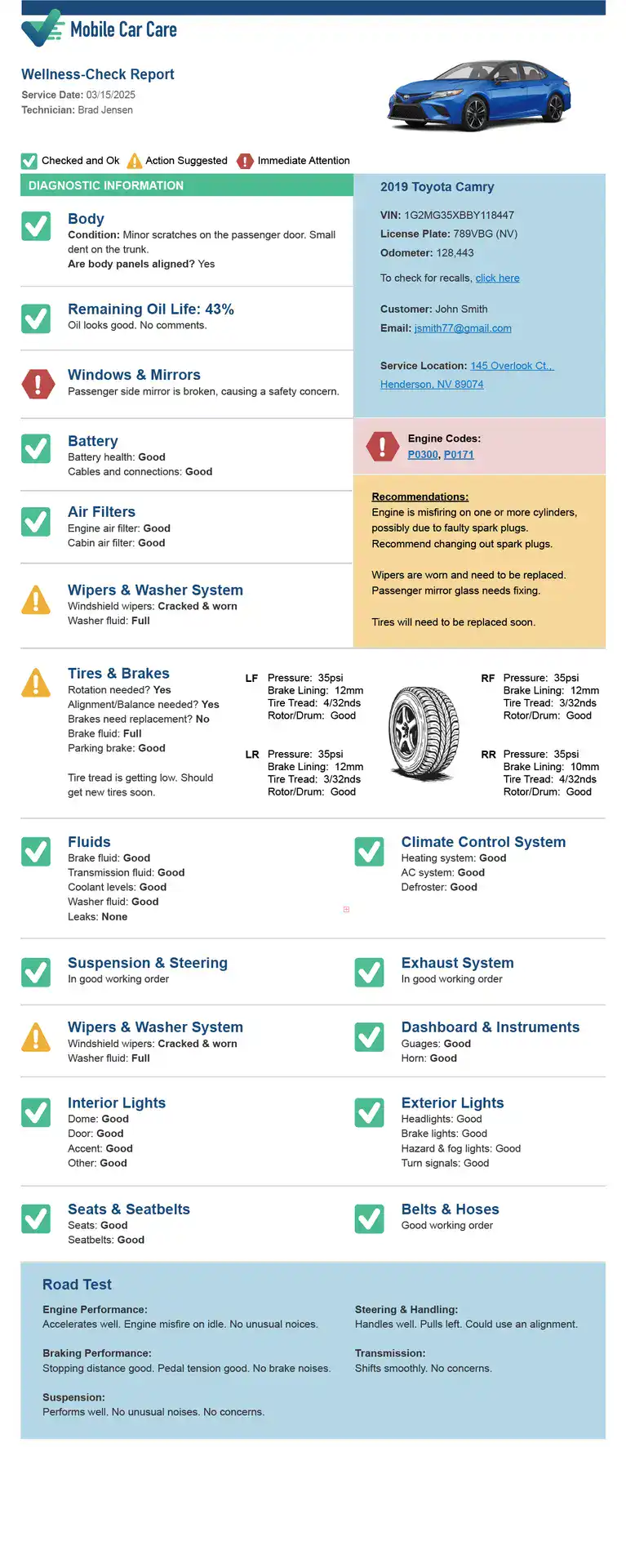
Have you ever left a mechanic feeling confused about what was actually wrong with your car? We believe in total transparency. After every inspection, you’ll receive a detailed, easy-to-understand report on your vehicle’s condition. We highlight what looks good, what needs attention soon, and what requires immediate action. Our reports are written in plain language, so you know exactly what’s going on.
If we find any small issues during the inspection, like a loose connection or a part that needs replacing, we can often handle minor repairs right on the spot. This saves you the trouble of a second appointment and gets you back on the road safely and quickly. You get clear information and convenient solutions, putting you in the driver’s seat of your car’s maintenance.
Related Articles
- What Is an Undercarriage Inspection & Why It Matters – Mobile Car Care
- Suspension Inspection: What to Expect & Costs – Mobile Car Care
- Alignment Check vs. Full Alignment: Which Do You Need? – Mobile Car Care
- Monthly Car Inspection Checklist for Students – Mobile Car Care
Frequently Asked Questions
My car seems to drift to one side. Is that a steering problem or something else? That’s a great question, and it’s one of the most common signs that something needs attention. While it feels like a steering issue, a car pulling to one side is most often caused by poor wheel alignment. Your steering and suspension systems are closely related, so our comprehensive inspection always includes checking your alignment and tire health to find the true source of the problem.
If my steering feels fine, do I really need an inspection? It’s smart to ask this, but yes, you absolutely do. Many serious steering problems begin with subtle wear and tear that you can’t feel from the driver’s seat. A professional inspection is designed to catch these small issues, like a minor fluid leak or a slightly worn joint, before they become noticeable and potentially dangerous. Think of it as preventative care that keeps you safe and helps you avoid a much bigger repair bill down the road.
What’s the difference between a steering inspection and a wheel alignment? This is a common point of confusion. A steering inspection is a complete diagnostic check-up of the entire system—the fluid, hoses, belts, tie rods, and all the connections. An alignment is a specific service where the angles of your wheels are adjusted. An inspection is what tells you if you need an alignment, along with checking the health of all the other parts.
How long does an on-site inspection usually take? Our comprehensive 85-point wellness check, which includes a thorough review of your steering system, typically takes about an hour to complete. The best part is that you don’t have to spend that time in a waiting room. We perform the entire service right in your driveway or office parking lot, so you can continue with your day without interruption.
What happens if you find a serious problem during an on-site inspection? Your safety is our top priority. If we find a minor issue, we can often perform the repair right on the spot. For more significant problems that require a full-service garage, we provide you with a detailed, easy-to-understand report. We’ll walk you through exactly what’s wrong and give you clear, honest recommendations for your next steps, so you can make an informed decision.