
Quarterly Vehicle Inspection Guide for Las Vegas
A quarterly vehicle inspection gives Las Vegas drivers a practical way to catch small problems before they become expensive repairs, missed work, or roadside breakdowns. Heat, stop-and-go traffic, long valley commutes, and older vehicles can all speed up wear. Checking the same core systems every few months helps owners move from reacting to trouble toward staying ahead of it.
Want a simpler maintenance rhythm? Explore the Essential Plan to see how Mobile Car Care uses recurring inspections, digital reports, and proactive recommendations.

Quarterly checks are especially useful for three groups in the Las Vegas Valley: drivers keeping older vehicles dependable, families managing multiple cars, and small businesses that cannot afford surprise downtime. A once-a-year look may miss changes that build between seasons. A quarterly cadence creates more opportunities to spot tire wear, weak batteries, fluid leaks, brake concerns, and other warning signs while the fix is still manageable.
Why quarterly inspections matter in Las Vegas
Vehicles in Southern Nevada work in conditions that can expose weak points quickly. Summer heat strains batteries, cooling systems, belts, hoses, tires, and air conditioning performance. Desert dust can shorten the life of filters. Daily traffic and frequent braking can make wear patterns show up faster than many drivers expect. A vehicle may feel fine in March and still need attention before peak summer or after months of heavy commuting.
A quarterly vehicle inspection is not about creating a repair list for its own sake. It is about building a repeatable checkpoint. Each visit answers a few simple questions:
- Has anything changed since the last inspection?
- Is a small issue moving toward a safety concern?
- Which items can be monitored, and which need action now?
- What should the owner plan for before the next season?
That rhythm matters because many breakdowns do not appear out of nowhere. They build. A battery begins to weaken. A tire wears unevenly. A minor seep becomes a more visible leak. A brake concern starts as a change in feel or remaining material. Regular review turns those clues into decisions.
What a quarterly vehicle inspection should cover
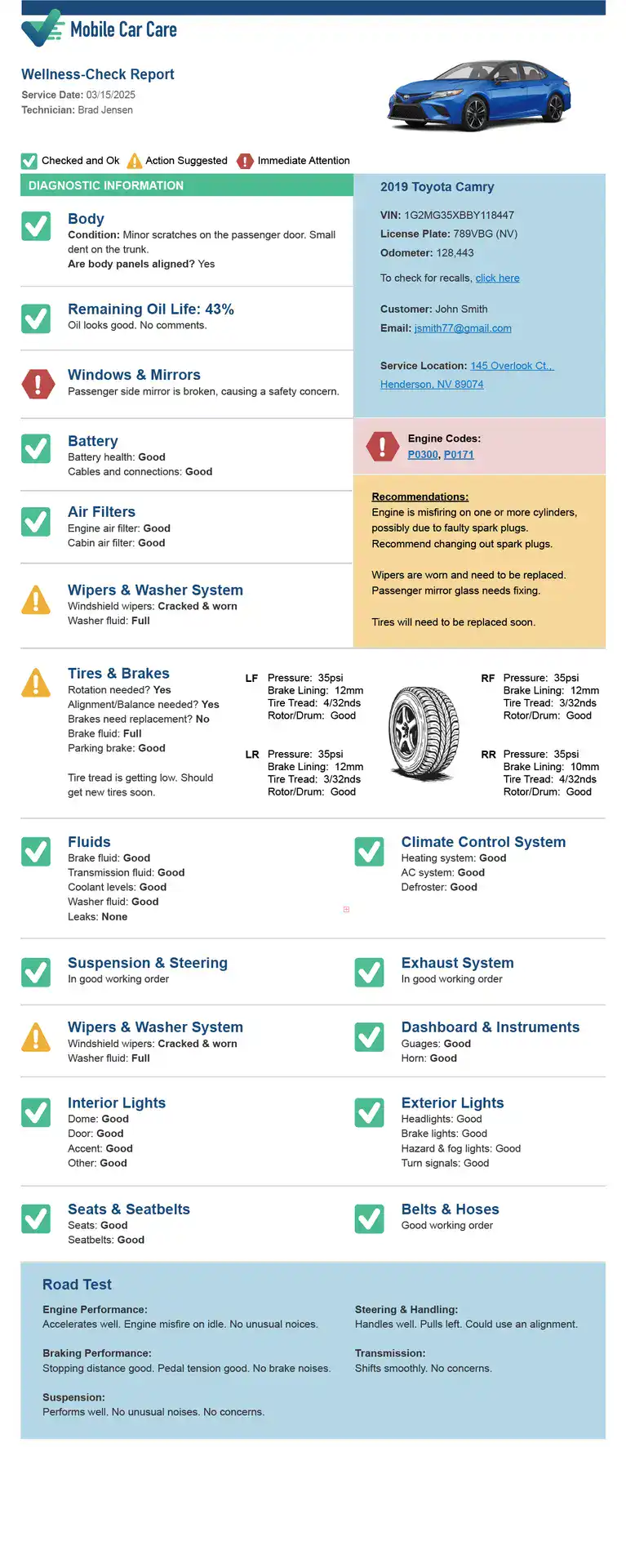
The most useful inspection combines safety checks, maintenance checks, and documentation. Mobile Car Care frames this through recurring vehicle wellness reviews and detailed digital reporting, which gives drivers a clearer picture than a quick visual glance in the driveway. For a deeper explanation of the report itself, see the 85-point inspection report guide.
Tires and tire wear
Tires affect stopping distance, ride quality, fuel use, and day-to-day confidence. During a quarterly review, a technician can look for uneven wear, low tread areas, damage, pressure concerns, and signs that alignment or suspension issues may be developing. In Las Vegas heat, tire condition deserves extra attention because underinflation and age can become more serious during long hot-weather drives.
A small example: a family vehicle may still steer normally, but one front tire could be wearing on the inside edge. Finding that during a scheduled inspection gives the owner time to investigate the cause before the tire becomes unsafe or needs premature replacement.
Battery health and starting reliability
Battery trouble often feels sudden to the driver, but the decline usually starts earlier. Slow starts, corrosion, heat stress, and weak test results can signal that reliability is slipping. A quarterly inspection helps owners prepare instead of discovering the problem in a parking lot or before a school pickup.
This is particularly relevant for older cars and vehicles that sit for long stretches. Seasonal residents, remote workers, and secondary household vehicles may not log many miles, but they can still develop battery problems. A scheduled look keeps those cars from being forgotten until they fail.
Fluid levels, condition, and leaks
Fluids help the vehicle cool, stop, steer, lubricate, and operate smoothly. A quarterly review can identify low levels, dirty fluids, visible seepage, or fresh signs of a leak. The owner does not need to guess whether a spot on the driveway is meaningful. A technician can document what is visible and recommend the next step.
Consider a small coolant seep near a hose connection. Catching it early may allow for a planned repair instead of a sudden overheating event in extreme heat. The value is not only the repair itself. The value is having enough warning to choose the timing.
Brake concerns
Brakes are easy to ignore until a sound, vibration, or longer stopping distance gets attention. A quarterly inspection creates a chance to review visible wear indicators, discuss changes in brake feel, and flag concerns that should be evaluated before they affect safety. For parents of teen drivers or households with an elderly family member on the road, that extra consistency matters.
One practical scenario is a business vehicle that runs short delivery routes. Frequent stops can accelerate wear even when annual mileage is modest. A recurring inspection pattern makes the vehicle easier to manage and helps the business plan service before a workday gets disrupted.
Belts, hoses, lights, filters, and visible wear
Not every preventable problem involves a major system. Cracked hoses, worn wiper blades, dim lights, dirty filters, or aging belts can all affect comfort, safety, or reliability. These smaller items fit naturally into a quarterly rhythm because they are easier to monitor when someone looks consistently.
Drivers who want a broader view of recurring maintenance can also review Mobile Car Care’s car maintenance checklist. That resource covers monthly, quarterly, seasonal, and annual habits, while this guide focuses on why the quarterly checkpoint is so valuable for breakdown prevention.
How quarterly checks help different drivers
The best maintenance plan fits the way a vehicle is used. Quarterly inspections are flexible because the same visit can support different priorities for different owners.
Older vehicles
Owners of 5+ year old vehicles often want to extend useful life without being surprised by avoidable failures. Quarterly inspections help establish a trend line. Instead of asking only whether a part has failed today, the owner can see what has changed since the last report. That helps with budgeting and reduces the urge to delay every maintenance decision until it becomes urgent.
Older cars also benefit from documentation. If one report notes minor tire wear and the next shows the same area worsening, the owner has clearer evidence that it is time to act. A repeated digital record makes those changes easier to understand.
Family cars
Families tend to place reliability above almost everything else. School, work, appointments, errands, and weekend obligations all depend on the car simply being ready. A quarterly vehicle inspection supports that by reducing blind spots. Parents can receive clear recommendations without trying to inspect every detail themselves.
For households managing more than one car, consistency matters even more. One vehicle may handle commuting. Another may carry young drivers. Another may be used less often by an aging parent. A recurring inspection schedule helps prevent the lowest-use vehicle from becoming the least monitored one.
Business vehicles
Small businesses often notice vehicle problems only when a route is delayed or an employee reports a concern. That is an expensive time to learn something was developing. Quarterly inspections help owners keep better records, spot common wear patterns, and plan service around operations.
The value is not limited to major failures. A weak battery, uneven tire wear, a fluid leak, or a brake concern can all create downtime. Catching those issues earlier supports safer employees, more predictable scheduling, and fewer last-minute interruptions.
Why recurring inspections work better than occasional checkups
An occasional inspection can be helpful, especially before buying a used car or leaving on a long road trip. But recurring inspections create a stronger preventive framework because they build context over time. Mobile Car Care’s model is designed around that idea: repeat visits, clear reports, and practical recommendations that help owners decide what to do next.
Need a consistent plan instead of one-off reminders? Review the Total Care Plan to compare a more comprehensive ongoing option.
Here is what that recurring approach changes:
- It creates comparison points. Drivers can see whether an issue is stable, improving, or getting worse.
- It reduces forgotten maintenance. The inspection becomes a scheduled touchpoint instead of a task that lives on a mental to-do list.
- It supports proactive decisions. Owners can plan repairs and maintenance around budget and schedule when possible.
- It adds documentation. Digital reports make it easier to understand what was checked and what was recommended.
This is also why quarterly inspections fit Las Vegas so well. The year naturally divides into moments when local driving conditions change. Before peak heat, after peak heat, before holiday travel, and after months of regular commuting, vehicles benefit from a focused review.
Examples of small issues that are easier to handle early
Preventive maintenance becomes more convincing when it is concrete. The goal is not to suggest that every small item becomes a crisis. The goal is to show that small findings are easier to evaluate, schedule, and address when they are found early.
| Early finding | What it may mean | Why timing matters |
|---|---|---|
| Uneven tire wear | Pressure, alignment, or suspension concerns may need review | Early action can help avoid premature tire replacement or reduced grip |
| Weak battery test result | The battery may be trending toward unreliable starts | Owners can plan replacement before a no-start surprise |
| Fresh fluid residue | A leak or seep may be starting | Documenting it early helps decide whether it needs prompt service |
| Brake wear concern | Wear may be reaching a point where further inspection is wise | Drivers can address safety-related issues before symptoms worsen |
These are the kinds of practical findings that make a quarterly schedule useful. They are not abstract maintenance ideas. They are the real clues that help drivers keep ordinary transportation problems from becoming stressful events.
What to expect from a digital inspection report
A useful report should help the owner understand the vehicle, not overwhelm them with jargon. Mobile Car Care emphasizes full digital reporting with photos, notes, and clear recommendations. That matters because the value of an inspection is not only what the technician sees. It is also whether the driver can make sense of the result.
A clear report can help an owner:
- Separate urgent issues from items that simply need monitoring
- Review photos or notes later instead of relying on memory
- Track repeat findings across multiple inspections
- Discuss repairs with more confidence when outside service is needed
For drivers who have felt confused after a rushed shop visit, that transparency is a major benefit. It supports the Mobile Car Care promise of simple, honest, and stress-reducing vehicle maintenance. To understand the broader service model, visit the Mobile Car Care homepage.
When should Las Vegas drivers schedule a quarterly inspection?
There is no single perfect calendar for every driver, but there are smart planning points. Many owners benefit from a quarterly routine that includes at least one inspection before the hottest stretch of the year and another after months of intense heat. Families may prefer to align inspections with school-year changes or travel periods. Businesses may choose a cadence that matches route volume or vehicle usage.
A quarterly vehicle inspection may be especially timely when:
- Your car is older and you want to reduce surprise repairs
- You have noticed small changes in starting, braking, tire feel, or fluid levels
- Your household depends on one or more vehicles every day
- Your business vehicles spend long hours moving around the Las Vegas Valley
- You want written documentation instead of guessing what deserves attention
Ready to put preventive maintenance on a repeatable schedule? See how recurring quarterly inspections fit into the Essential Plan.
Quarterly inspections make prevention easier
The best maintenance system is the one that actually happens. A quarterly inspection works because it is frequent enough to catch meaningful changes, but simple enough to fit into normal life. For Las Vegas drivers, it creates a dependable way to monitor the parts of a vehicle that heat, age, and daily use can stress most.
Older-car owners gain better visibility into what is changing. Families gain confidence that important vehicles are not being overlooked. Business owners gain a more predictable way to reduce downtime and organize maintenance. Across all three groups, the core benefit is the same: fewer surprises and better decisions.
Mobile Car Care built its subscription approach around that preventive mindset. Recurring inspections, digital reports, and practical recommendations help drivers act earlier, plan better, and keep their vehicles moving with less stress.